
Ask a Paris Therapist: Jessamy Holland on Healthy Relationships and Thriving in a Bicultural Couple

If you've ever tried to build a relationship — or a family — across two cultures, two languages, or two very different upbringings, you know it takes more than love to make it work. It takes translation. Patience. And, often, a little outside perspective.
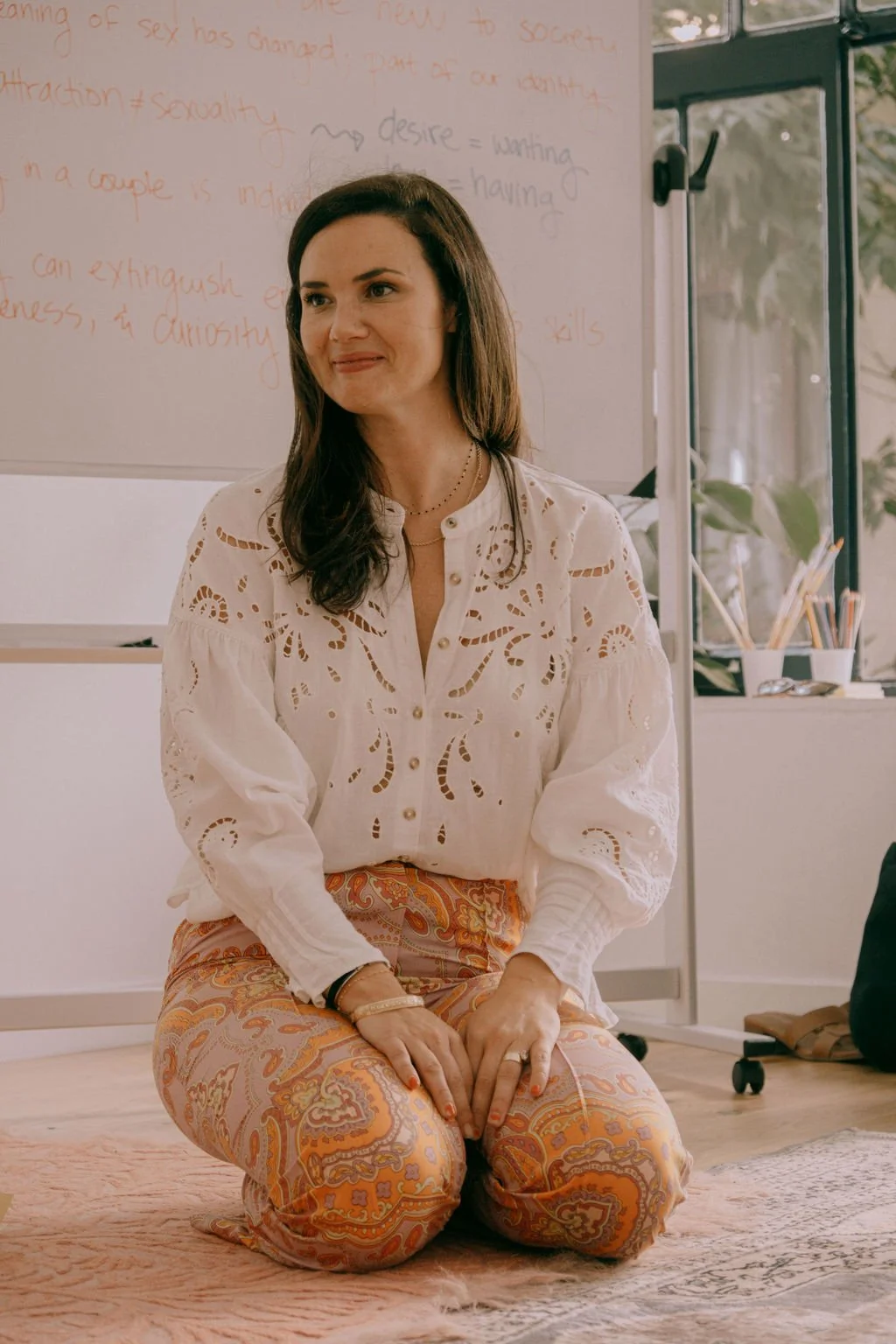
That's exactly what Jessamy Holland, a Paris-based sex and relationship therapist, offers the international couples in our community. Jessamy works with English- and French-speaking couples and individuals navigating everything from cross-cultural communication to intimacy to the particular kind of depletion that comes with parenting far from home.
We sat down with Jessamy to talk about her path to Paris, the patterns she sees most often in her practice, and the small, doable rituals that keep a relationship — and a nervous system — regulated.
From Honolulu to Paris: How Jessamy Became a Relationship Therapist

Tell us about your background and how you ended up in France.
I was born and raised in Honolulu, Hawaii and then went to university in Portland, Oregon. I studied psychology, and did a semester abroad in Strasbourg. It started my interest in living in France, and I began putting out feelers to find a job in Paris for when I graduated. I connected with the American School of Paris, and they offered me a position as a counselor implementing a peer mentoring program in the high school. They also asked me to coach the girls varsity volleyball team, as I played throughout college. It was through coaching at ASP that I met my husband, who was the boys varsity soccer coach.
I knew that I wanted to continue my studies, and after having turned down a masters at NYU (my dream program!) to stay in France and pursue my life and relationship here, I began my masters diploma in sex and relationship therapy in London in 2015, going back and forth on the Eurostar every other weekend. It was a great experience, but it implied that I would have to start an internship in London to complete the degree. I managed to create my own internship through beginning a heavily-supervised practice in Paris, which gained me both experience and connections with other therapists. After doing that part-time and working at both ASP and Marymount International School, I realized that I needed to commit to full-time therapy if I wanted it to work. So in 2020, after having stayed home full-time for two years after the birth of my son, I decided to go back to work as a sex and relationship therapist.
What drew you to this mix of couples therapy, sexology, and existential coaching?
After working for a couple of years in the high school at ASP, the middle school director asked me to create and implement a curriculum for the health program. Part of that curriculum was designed around sex education, and I found this to be a genuinely enriching and beneficial subject for the 6th, 7th, and 8th graders. I also realized that I wanted to learn more about how to teach the subject, which led me to finding the London Diploma of Psychosexual and Relationship therapy in London. I applied and was accepted to the program through Middlesex University.
As a child, I saw my parents struggling with their relationship but never talked about it. I wasn't modeled how to communicate about emotions, and there was a lot of confusion around what was happening "up there" in the adult world from the minute I was born. So I've always had a skill set around understanding and navigating emotions because that's what makes me feel safe. I was drawn to couples therapy work because of that skill set that I've been honing since a child.
Existential coaching has been a new feather added to my cap since I graduated last year from another program run through Middlesex University. I have been interested in and drawn to existential themes like control, agency, meaning, and time as a therapist and as a person. I have also seen an increase in these themes — especially around anxiety and angst — in recent years in my practice and wanted to feel more skilled in addressing them with my clients.
How would you describe your approach in a sentence or two?
My therapeutic approach combines an integrative approach to working with English- and French-speaking couples and individuals, including the humanistic psychology approach of person-centred therapy. I am also a promoter of somatic healing practices, and include body scanning, breath work, and nervous-system regulation in my sessions.
How would you define a "healthy relationship"?
A healthy relationship is a relationship where both partners are able to engage in a tension-filled conversation while maintaining a regulated nervous system and open communication.
The Most Common Relationship Challenges Jessamy Sees in Her Paris Practice

What are the most common relationship challenges or themes people bring to you?
Some common relationship challenges I see in my office include: difficulty initiating or engaging in physical intimacy, feeling invalidated or unheard, and feeling misaligned with emotional, psychological, or physical needs.
Which challenges are unique to bicultural couples?
Potentially unique to bi-cultural couples: understanding and communicating (cultural factors) in why/how a partner avoids or confronts emotions, educating children about values/behaviors, navigating family-in-law relationships.
Is there a complaint that seems small but usually signals something bigger?
Whenever the words "always" or "never" are used, something bigger is often underneath. Also, anger is usually a signifier for something deeper around fear that's being activated.
What small changes have you seen make the biggest impact for your clients?
If a pre-menopausal woman knows how to track her menstrual cycle, this can really help her partner know when and how to communicate with her.
Teaching couples how to formulate their thoughts around the message they're trying to communicate before they communicate is a small change that has a big impact. Also, timing and tone of communication — these are both important factors in delivering a message so that the person receiving it doesn't feel attacked and get defensive.
For Depleted Mothers: How to Stop Pouring From an Empty Cup
What would you say to the women — mothers especially — who feel depleted by their many responsibilities and feel like they have little left to give their partner?
That they need to spend time figuring out what fills their cup the "most" (e.g. alone time, time with friends, gym time, shopping, working, writing, etc.) and focus on carving out (e.g. explicitly asking for) that time for themselves at almost any cost.
Know how to delegate and ask for help. Burn out comes from perceived expectations outweighing internal resources, so creating a community or network of help so that you can (re)fill your internal resources by diminishing the number of responsibilities you're handling solo will help a lot.
Simple Relationship Rituals That Actually Strengthen a Couple
What are some rituals or practices that can help strengthen a couple?
Eye-gazing for ten minutes every day. Physiologically this creates connection and a feeling of safety.
Being polite and thoughtful. For example, saying hello, goodbye, good morning, and goodnight. These create demarcations of time that let the other person know that you are aware of them and their presence in your life.
What is an underrated relationship skill you recommend everyone develop?
Encouraging separateness, giving your partner space and freedom, so that you can come together afterwards and "see" each other from across that space. Not being afraid to see your partner excel at something or do something that they love like a hobby (as long as you feel like there are equal opportunities for you to have that space). As couples march through their lives together, we often don't take space for ourselves, or feel guilty when we do (or resentful when they do).
When to See a Couples or Sex Therapist
At what point should someone consider seeing a couples or sex therapist?
It's always a good time to see a couples therapist — the more proactive you are in getting in front of tricky or sticky dynamics that don't feel great for either partner, the better. Or if you're going through a transition (pregnancy, professional, moving) and need an extra set of eyes to help you see things differently.
Sex therapist — if there is pain or discomfort during sex and you've ruled out anatomical origins as the cause. Or if there's been a history of sexual assault or harassment which is unprocessed and hindering you from sexual pleasure.
Any misconceptions about couples therapy you'd like to dispel?
A misconception is that couples therapy (or therapy in general really) is for people in crisis. Therapy is a place to unpack bags (heavy or light) to understand what you're carrying around with you, so that you can then have more choice around how to walk through the world. Therapy helps you to have more awareness (and therefore words) to express what living your life is like for you, which then makes it easier to ask for what you need and want from a partner.
Is there one piece of advice you think all couples could benefit from?
Don't be afraid to be vulnerable; it's not a sign of weakness but of strength.
About Jessamy Holland

Jessamy Holland, MSc — Sex and Relationship Therapist
Jessamy works with English- and French-speaking couples and individuals in Paris, blending an integrative, person-centred approach with somatic tools like body scanning, breath work, and nervous-system regulation.
Website: jhollandtherapy.com
Instagram: @__jessholland__
Book a session: calendly.com/jessamyholland/30min
Real talk like this is a regular thing in our circle.
Well in France is the Paris wellness community for international women — think intimate dinners, expert-led talks, and immersive retreats that make you feel more alive and aligned. Come join us and meet your people in Paris.